 +44 28 3718 0055
About the Journal
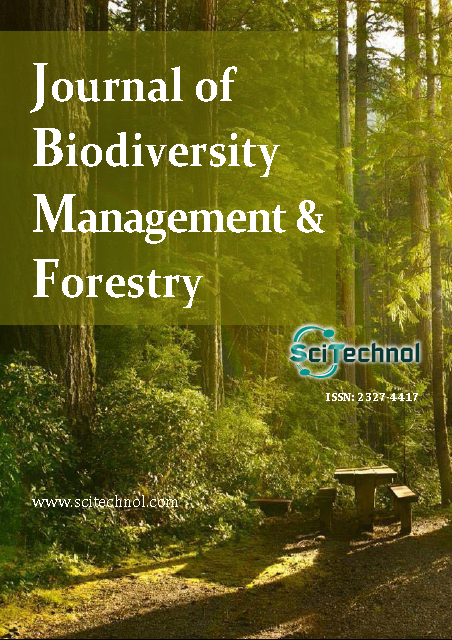
Journal of Biodiversity Management & Forestry is a peer-reviewed scholarly online journal and aims to publish the most complete and reliable source of information on the discoveries and current developments in the mode of original articles, review articles, case reports, short communications, etc. in all major themes pertaining to biodiversity & forest management and wildlife management making them accessible online freely without any restrictions or any other subscriptions to researchers worldwide.
Journal of Biodiversity Management & Forestry focuses on the topics that include:
- Biodiversity Conservation
- Biodiversity Management
- Forest Biodiversity & Conservation
- Forest Ecology & Ecosystem Services
- Forests & Forest Products
- Sustainable Forest Management
- Restoration Ecology
- Non-Timber Forest Products
The journal is using Editorial Manager System for quality in review process. Editorial Manager is an online manuscript submission, review and tracking systems. Review processing is performed by the editorial board members of Journal of Biodiversity Management & Forestry or outside experts; at least two independent reviewers approval followed by editor approval is required for acceptance of any citable manuscript. Authors may submit manuscripts and track their progress through the system, hopefully to publication. Reviewers can download manuscripts and submit their opinions to the editor. Editors can manage the whole submission/review/revise/publish process.
Submit your manuscript through Online Submission System or send as an e-mail attachment to the editorial office at manuscript@scitechnol.com
Forest Microbiology
This laboratory is working on understanding the activities of living organisms in the forest, like trees and mushrooms, from the organic and biochemical point of view. We are also doing research on how these actions can be used to enhance human life, such as by breaking down and detoxifying environmental pollutants, and searching for physiologically active substances obtainable from trees. It plays the role of a natural preservative that prevents timber from decaying easily. Although ordinary micro organisms like bacteria and fungi cannot decompose lignin, there is one oddball micro organism in forests that does break lignin down. This micro organism is called white-rot fungus because it makes timber turn white and decay.
Forest Entomology
It is applied ecology with its scientific roots in silviculture and population ecology of insects. The main focus in forest entomology is on the insect pests of the forests and how damage can be prevented or controlled. In later years the field of interest has been broadened to include the insect community in the forest ecosystem with a special focus on the dual role of dead wood as breeding material for pest species and a necessity for endangered saproxylic insects. The interaction between the insect and its host is of fundamental importance for the understanding of how insect outbreaks occur and develop, and how to avoid or counteract damage in the best possible way.
Forest Genetics
A successful tree breeding and improvement program reduced plantation failures and realized economic gains in tree growth and product quality. Today, managing and conserving forest genetic resources are essential components of forest stewardship, contributing to B.C.’s position in a globally competitive forest industry. The Ministry of Forests and Range Forest Genetics research program includes not only tree improvement, but a wide range of initiatives related to genetic conservation, genetic resources management, and identifying and developing mitigation strategies for climate change impacts.
Wildlife Biology
Wildlife Biology is the observe and study of behaviour of animals. They frequently observe the features of certain wildlife and determine the creatures' role in specific ecosystems and/or how they interact with human beings. In addition, they will often perform various experiments to either increase our knowledge about a certain species or see how humans influence the ecosystem in question. Many Wildlife Biologists will eventually specialize into a particular area of study defined by ecosystem or species. Some of these fields include: Entomology, Ornithology, Marine Biology, or Limnology.
Forest Policy and Economics
Policy issues, including economics and planning, relating to the forest and forest industries sector. Its aims are both to publish original papers of a high scientific standard, and to enhance communications amongst researchers, legislators, decision-makers and other professionals concerned with formulating and implementing policies for the sector.
Forest Pathology
It is generally the study of diseases happens to trees. It is generally classified into biotic, abiotec and decline diseases. The plant pathology will put high impact on the crop production of the country. So reducing the plant diseases and losses of forest is the biggest concern of forest pathologist. A plant disease is defined as a sustained disruption in physiological or structural functions of a plant due to an attack by a pathogen that results in death, damage to cells or tissues, reduced growth or vitality, or economic losses. A disease is an interaction between a pathogen and its host that can only occur under certain environmental conditions.
Biodiversity and Conservation
Biodiversity refers to the variety of all forms of life on earth, including the different plants, animals, micro-organisms, the genes they contain and the ecosystem they form. It is considered at three main levels including species diversity, genetic diversity and ecosystem diversity. Articles on all aspects of biological diversity, its description analysis, conservation and its controlled rational use by humankind. The Journal also provides a forum for examining the conflicts between sustainable development and human dependence on biodiversity especially in such fields as agriculture environmental management and biotechnology.
Biodiversity Management
Biological diversity means the variability among living organisms from all sources including, inter alia, terrestrial, marine and other aquatic ecosystems and the ecological complexes of which they are part; this includes diversity within species, between species and of ecosystems.”The management of Biodiversity can be done by Managing the sustainable forest and harvesting Trees, and the Ecological Restoration.
Forest Biodiversity & Conservation
Forests are biologically diverse systems, representing some of the richest biological areas on Earth. They offer a variety of habitats for plants, animals and micro-organisms. However, forest biodiversity is increasingly threatened as a result of deforestation, fragmentation, climate change and other stressors. Tropical, temperate and boreal forests offer a diverse set of habitats for plants, animals and micro-organisms. Consequently forests hold the majority of the world’s terrestrial species. However these biologically rich systems are increasingly threatened, largely as a result of human activity.
Forest Ecology & Ecosystem Services
Forest ecosystems deliver multiple goods and services and, traditionally, forest owners tend to have a high interest in goods in the form of merchantable wood. As a consequence, forest management often aims to increase timber production and economic returns through intervention into natural processes. However, forests provide further services, including carbon sequestration, water quantity and quality, and preservation of biodiversity. In order to develop and implement strategies for sustainable forest management, it is important to anticipate the long-term effects of different forest management alternatives on the ability of the forest to provide ecosystem goods and services.
Forests & Forest Products
The life on this planet begins as forest dwellers. They continued to depend on forests to meet a lot of their needs. Even today people depend on the forest for paper, timber, fuel wood, medicine, and fodder. The basic forest product people generally used by the people are bamboos, canes, fruit, fiber, timber, medicinal plants, grasses and essential oils.
Sustainable Forest Management
Sustainable forest management addresses forest degradation and deforestation while increasing direct benefits to people and the environment. At the social level, sustainable forest management contributes to livelihoods, income generation and employment. At the environmental level, it contributes to important services such as carbon sequestration and water, soil and biodiversity conservation. Many of the world's forests and woodlands, especially in the tropics and subtropics, are still not managed sustainably. Some countries lack appropriate forest policies, legislation, institutional frameworks and incentives to promote sustainable forest management, while others may have inadequate funding and lack of technical capacity. Where forest management plans exist, they are sometimes limited to ensuring the sustained production of wood, without paying attention to the many other products and services that forests offer.
Restoration Ecology
Ecological restoration is an intentional activity that initiates or accelerates the recovery of an ecosystem with respect to its health, integrity and sustainability. Frequently, the ecosystem that requires restoration has been degraded, damaged, transformed or entirely destroyed as the direct or indirect result of human activities. In some cases, these impacts to ecosystems have been caused or aggravated by natural agencies such as wildfire, floods, storms, or volcanic eruption, to the point at which the ecosystem cannot recover its pre disturbance state or its historic developmental trajectory. Restoration attempts to return an ecosystem to its historic trajectory. Ecological restoration is the process of assisting the recovery of an ecosystem that has been degraded, damaged, or destroyed.
Non-Timber Forest Products
Non-timber forest products (NTFPs) are any product or service other than timber that is produced in forests. They include fruits and nuts, vegetables, fish and game, medicinal plants, resins, essences and a range of barks and fibers such as bamboo, rattans, and a host of other palms and grasses. Over the past two decades, governments, conservation and development agencies and non-government organizations have encouraged the marketing and sale of NTFPs as a way of boosting income for poor people in the tropics and encouraging forest conservation. But different users define NTFPs differently, depending on their interests and objectives. At CIFOR, the emphasis is on understanding how people use forest resources, and on helping to improve the contribution these resources make to the livelihoods of the world’s rural poor. Accordingly, CIFOR uses an inclusive definition of NTFPs — one that even encompasses wood products, such as those used for woodcarving or fuel.
Forest Product Trading
The forest products sector is estimated to contribute about 1.2 percent of world GDP and approximately 3 percent of international merchandise trade. Industry annual turnover exceeds US$200 billion for four product categories: round wood and sawn wood, panels, pulp, and paper. The forest products industry is employing over 13 million people in nearly 200 nations; STATE OF THE WORLD’S FORESTS 2005.The timber based forest product trading will put a bad impact on the enviourmental condition like bad weather effects, lack of rainfall by cutting the trees or trading of the wood products. To avoid such kind of problem the people should focus on the non timber forest products.
Soil Conservation
It generally aims to prevent the loss of soil. So agriculture is the is the best way to avoid such type of problems. The various methods are adopted for conservation of the soil like Agronomic practices, Contour farming, Mulching, crop rotations, Field strip cropping, Dry farming method etc. A sequel to the deforestation is typically large scale erosion, loss of soil nutrients and sometimes total desertification.
Ecological Behavior
Shrinking natural resources, overwhelmed landfill sites, pollution, the depletion of the ozone layer, and the greenhouse effect challenge human existence. Behavioural ecology in its broadest sense is the study of adaptations, and the selective pressures that yield them, in different ecological environments. Some adaptations are behavioural and sometimes behavior drives the evolution of new adaptations by creating new selective environments.
Environmental Management
It is the Management and control on human impact for saving the natural resources of the environment. Hence the environmental management system came in to force to control this kind of the activity and protect the biodiversity. the basic benefit of the envoimental management system is Improved environmental performance, Enhanced compliance, Pollution prevention, Resource conservation, New customers/markets etc.
Marine Biodiversity
Biodiversity is 'Life on Earth'. The marine biodiversity refers to the life present under water. Marine biodiversity is important to protect because today, just as always, humans are dependent on the Earth's resources for their livelihood, health and well being In Belize, efforts have been made to conserve the incredible biodiversity that exists in the country. In addition to seasonal closures and catch limits on some fishery products, many national parks and marine reserves have been established in an effort to protect these natural areas.
Wildlife Risk
Wildlife risk refers to free-living wild animals can be classified into three major groups on the basis of key epizootiological criteria: (I) Risks associated with “spill-over” from domestic animals to wildlife populations living in proximity; (ii)Risks related directly to human intervention, via host or parasite translocations; and (iii)Risks with no overt human or domestic animal involvement.
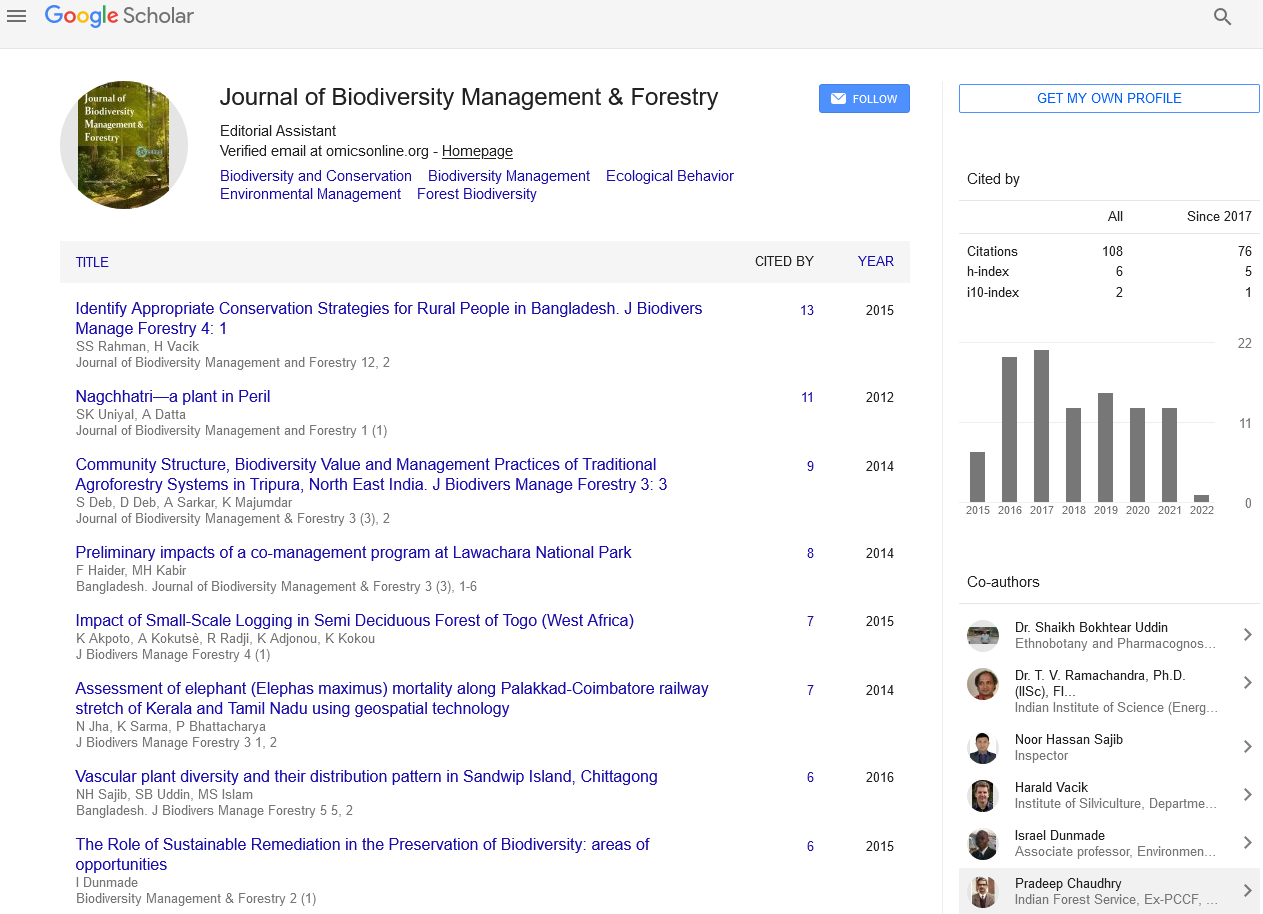
*2017 official journal impact factor is the ratio of the number of citations achieved in the year 2017 based on Google search and Google scholar citations to the total number of articles published in the last five years i.e. 2012 to 2016. Impact factor measures the quality of the journal.
If ‘X’ is the total number of articles published in 2012 to 2016, and ‘Y’ is the number of times these articles were cited in indexed journals during 2017 then, impact factor = Y/X.
Fast Editorial Execution and Review Process (FEE-Review Process):
Journal of Biodiversity Management & Forestry is participating in the Fast Editorial Execution and Review Process (FEE-Review Process) with an additional prepayment of $99 apart from the regular article processing fee. Fast Editorial Execution and Review Process is a special service for the article that enables it to get a faster response in the pre-review stage from the handling editor as well as a review from the reviewer. An author can get a faster response of pre-review maximum in 3 days since submission, and a review process by the reviewer maximum in 5 days, followed by revision/publication in 2 days. If the article gets notified for revision by the handling editor, then it will take another 5 days for external review by the previous reviewer or alternative reviewer.
Acceptance of manuscripts is driven entirely by handling editorial team considerations and independent peer-review, ensuring the highest standards are maintained no matter the route to regular peer-reviewed publication or a fast editorial review process. The handling editor and the article contributor are responsible for adhering to scientific standards. The article FEE-Review process of $99 will not be refunded even if the article is rejected or withdrawn for publication.
The corresponding author or institution/organization is responsible for making the manuscript FEE-Review Process payment. The additional FEE-Review Process payment covers the fast review processing and quick editorial decisions, and regular article publication covers the preparation in various formats for online publication, securing full-text inclusion in a number of permanent archives like HTML, XML, and PDF, and feeding to different indexing agencies.